Music Production Data Lab
Public-safe relational data model with a reproducible Python/SQLite workflow, SQL reporting views, automated data-quality checks, and a documented Power BI semantic model with version-controlled DAX measures
View repository · Read the full README · DataTideHH portfolio
Project purpose
The source domain is a music-production setup, but the portfolio focus is Data/BI and process analysis:
- turn semi-structured domain notes into controlled tabular data
- model equipment, references and workflows through stable identifiers
- validate relationships, quality status and publication boundaries
- build a reproducible SQLite data product
- generate reporting datasets from SQL-backed views
- document a Power BI semantic model and DAX layer
- interpret results for a technical or non-technical reviewer
Current sample
| Entity | Rows |
|---|---|
| Equipment | 30 |
| Music references | 12 |
| Soundchains | 12 |
| Ordered equipment uses | 53 |
The sample is curated and public-safe. It is not a complete private inventory.
Key metrics
| Metric | Result |
|---|---|
| Equipment workflow coverage | 80% |
| Reused equipment items | 16 |
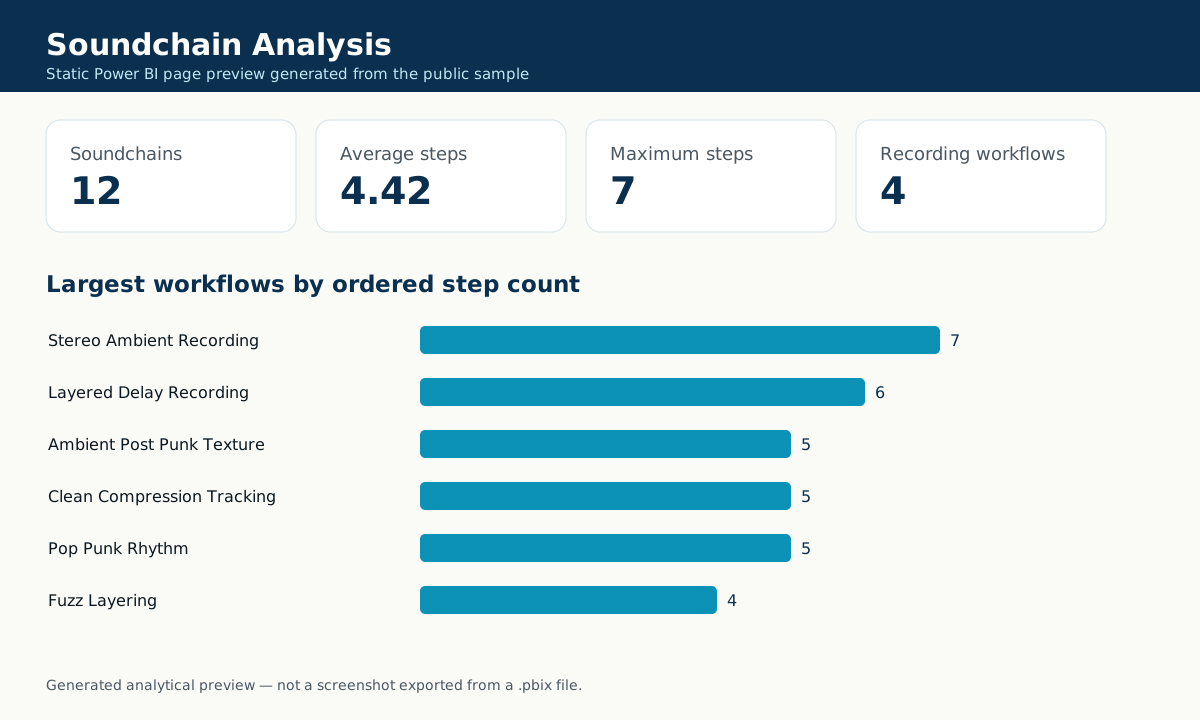
| Recording workflows | 4 |
| Average steps per soundchain | 4.42 |
| Maximum steps | 7 |
| Equipment items needing verification | 1 |
Read the generated analysis summary · Read the findings
Reporting workflow
public CSV source data
-> Python validation
-> SQLite relational model
-> reporting views and analytical SQL
-> generated reporting CSVs
-> Power BI semantic model and DAX
-> reviewed visual evidence
Power BI evidence
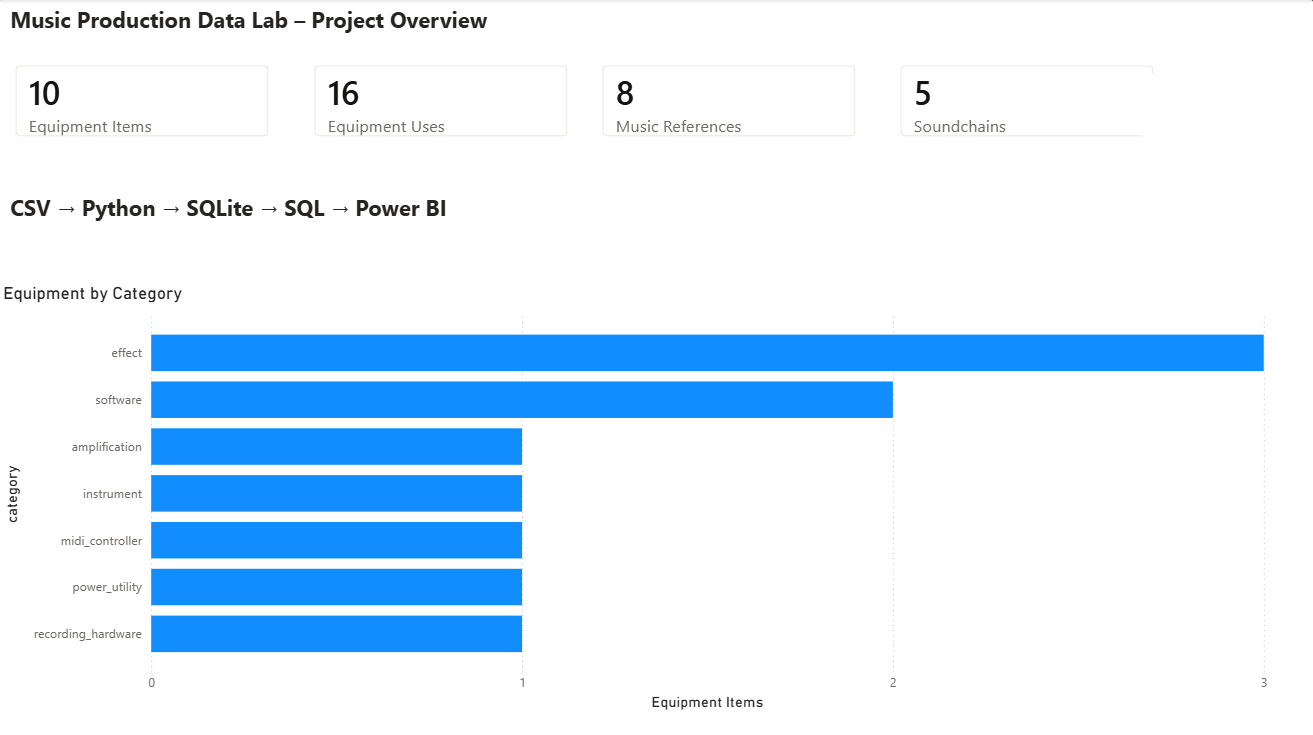
Existing reviewed overview
Soundchain Analysis preview
Data Quality and Coverage preview
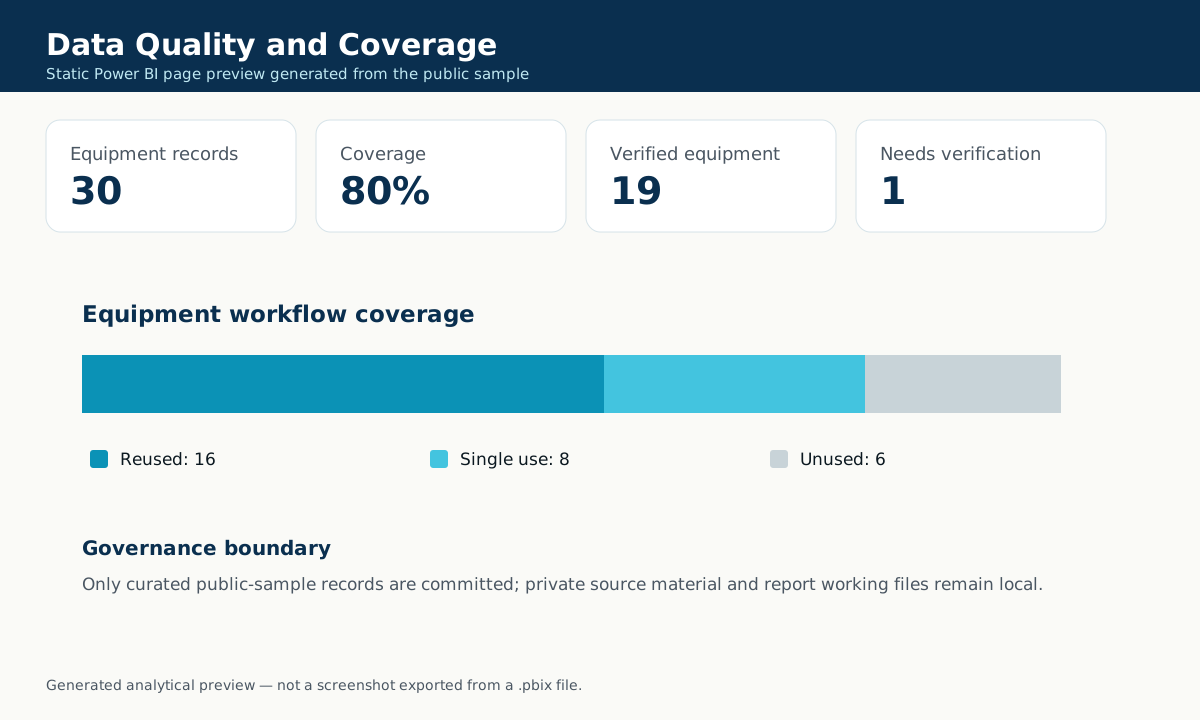
The two SVG pages are deterministic, data-backed previews and are not represented as screenshots exported from a .pbix file.
Portfolio artifacts
| Artifact | What it demonstrates |
|---|---|
| Generated analysis summary | Reproducible metrics and ranked outputs |
| Findings and interpretation | Business-readable interpretation of reuse, complexity and quality |
| Data model | Entities, bridge table and relationship decisions |
| Data dictionary | Controlled values and validation rules |
| Testing and CI | Cross-platform reproducibility and stale-output detection |
| Power BI plan | Page goals and reporting questions |
| Power BI model | Relationships, active/inactive paths and data types |
| DAX measures | Version-controlled BI calculations |
| Publication policy | Public/private boundary |
Main findings
- 24 of 30 equipment records are used in at least one workflow.
- shared platform items create the highest reuse across workflows.
- recording workflows are fewer but include the largest chains.
- required, optional and swap-candidate roles support dependency analysis.
- quality status is exposed to reporting instead of being hidden.
Related DataTideHH project pages
- Network Operations Data Lab — operational IT data, Python, SQL and data quality
- Spring Boot Process API Basics — Java/Spring process API evidence